
Table of Contents
We have all been there. You are at a family gathering, a puja, or a playdate, and a well-meaning relative asks, “Oh, your little one isn’t walking yet? My grandson started running when he was 9 months old, and he’s already reciting the Gayatri Mantra!”
Suddenly, that knot of worry tightens in your stomach. In the competitive landscape of Indian parenting, the pressure to ensure our children are not just on time but ahead of the curve—whether in walking, talking, or eventually, securing that IIT seat—is immense. We often panic and frantically Google childhood development stages, wondering if we are failing as parents.
But before you let this pressure consume you, let us delve into what the “norm” truly means. Understanding the real science behind childhood development stages will not only ease your anxiety but also empower you to be a supportive, informed, and relaxed parent.
1. What Are Childhood Development Stages Really? The Myth of the Average
When you open a growth chart, you see clean lines and specific dates: 6 months for sitting, 12 months for walking. These figures are derived from studies of thousands of children globally and represent statistical averages.
Think of it like this: Imagine a train station where three trains are heading to the same city. One leaves at 8:00 AM, one at 9:00 AM, and one at 10:00 AM. The average departure time is 9:00 AM. But every train still reaches the same destination safely. Your child is one of those trains.
Your child is not a statistic. They are a unique individual whose development is influenced by genetics, environment, temperament, and even birth order. These charts are merely tools that help you identify skills within a specific timeline window, not a fixed deadline.
2. The Golden Rule: Guidelines, Not Deadlines
The most important thing for Indian parents to internalize is that developmental milestones are just guidelines. There is a wide, healthy range for every milestone. For instance, a child can begin walking anytime between 9 and 18 months and still be considered perfectly normal.
Knowing these stages allows you to intervene gently, not forcefully. You use this knowledge to help your child, or to “pull back” if you realize you are expecting too much from the child at any given stage. The pressure to speed up the process can actually create stress and resentment, which is counterproductive to healthy growth.
3. Deeper Dive: The Pillars of Development
To truly understand childhood development stages, we must categorize the skills into four core pillars. A child may excel in one area (like Gross Motor) and take their time in another (like Speech).
A. Gross Motor Skills (The Big Moves) 💪
These skills involve the large muscles of the body that control movement, balance, and posture.
| Age Range | Key Milestone | Actionable Activity for Indian Parents |
| 0–3 Months | Head and Shoulder Control | Increase tummy time gradually. Use colorful dupattas or bright toys to encourage lifting the head. |
| 4–6 Months | Rolling and Sitting | Support the child in a seated position using rolled blankets or pillows (like gaddis). |
| 7–9 Months | Crawling/Creeping | Create a safe, clean space (galiicha) on the floor and scatter favorite toys just out of reach. |
| 10–12 Months | Pulling to Stand, Cruising | Let the child cruise along sturdy furniture (like the dining table or sofa back). |
| 1–2 Years | Walking Independently | Encourage walking outdoors (safely) and climbing low stairs (with supervision). |
- Warning Sign: Low muscle tone, characterized by a floppy feeling or inability to lift the head or bear weight, can be a potential red flag for genetic or muscular disorders, such as Down syndrome.
B. Fine Motor Skills (The Small Tasks) ✍️
These skills involve the small muscles of the hands and fingers, essential for dexterity and independence.
- The Grasping Sequence:
- Palmar Grasp: Using the whole hand (5-6 months, like grabbing a large laddu).
- Pincer Grasp: Using the thumb and index finger (9-12 months, crucial for picking up small dal or chana).
- Self-Feeding & Grooming: Fine motor skills dictate a child’s ability to self-feed (holding a spoon or managing roti pieces), write legibly, and perform personal grooming tasks like zipping and buttoning.
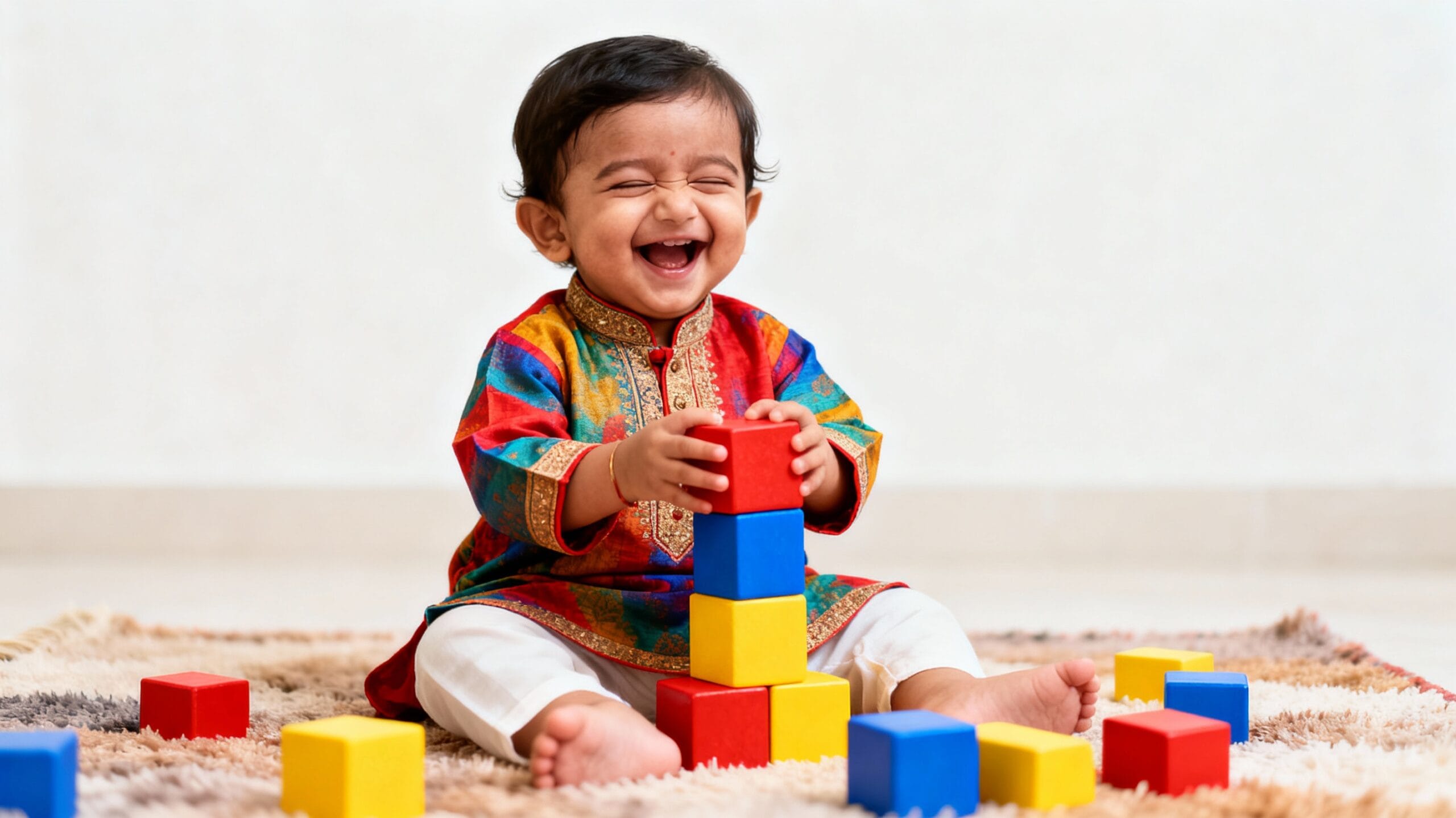
- Activities: Encourage playing with building blocks, stacking rings, kneading atta (dough) with you, or scribbling with crayons.
C. Cognitive Skills (Thinking and Learning) 🧠
This pillar is all about how your child processes information—their memory, logic, and problem-solving abilities.
- Object Permanence: This cognitive breakthrough (around 8 months) is when a baby realizes things exist even if they can’t see them. This is why “peek-a-boo” (or chuppan-chuppai) is so fascinating to them!
- Attention Spans:
- Sustained Attention: Staying focused on one toy or activity.
- Selective Attention: Tuning out the loud diwali fireworks to focus on your voice.
- Working Memory: Holding a thought in mind while using it (like following a two-step command: “Take the ball and put it in the basket”).
- Boosting Cognition: Simple puzzles, shape sorters, and reading stories (encouraging prediction) are excellent brain-training tools.
4. Speech and Social Stages (Connection and Communication)
A. Speech Development and Bilingualism
For Indian families, many children are exposed to two or more languages (Hindi/English, or regional languages). Research confirms that this does not cause delays; it is a cognitive advantage. However, be aware of the stages:
| Age Range | Key Speech Stage | Parental Role |
| 0–6 Months | Cooing and Vocal Play | Respond immediately to their sounds. Imitate their “aah” and “ooh” sounds. |
| 6–12 Months | Babbling (Dada, Mama) | Name objects they look at (“That is a Gadi/car”). Talk to them in both languages clearly. |
| 12–18 Months | First 10–20 Words | Focus on nouns (ball, pani, mummy). Repeat and expand their words (“Yes, that’s a big ball.”). |
| 2–3 Years | Short Sentences | They become “chatterboxes.” Encourage storytelling and asking “why” and “what” questions. |
- Red Flag: Lack of back-and-forth communication or not responding to their name by 12 months.
B. Building Strong Social Skills
Social development starts with the parent-child bond (attachment) and expands to peers.
- Attachment: The primary caregiver’s consistent love and respect forms the basis for all future relationships.
- Play Stages:
- Parallel Play (2 Years): Playing next to another child, but not with them. (Common in Indian joint families where many cousins are around).
- Cooperative Play (4+ Years): Playing together, sharing, and following rules (essential for games like cricket or gulli-danda).
- Handling Anxiety: Separation anxiety is normal when the child realizes they are a separate person (around 8-18 months). Be consistent, keep goodbyes short, and always follow through on your promise to return.
[Internal Link Placeholder: Read more about our guide to Positive Parenting and Bonding Techniques here]
5. The Role of Environment, Nutrition, and Culture
A child’s development is not just about genetics; it is about the mahaul (environment) we create.
- Nutrition: Ensure a balanced diet rich in iron and Omega-3 fatty acids (found in fish, nuts, and almond/akhrot). These are crucial for myelination, which speeds up brain processing.
- Cultural Practices: The traditional practice of daily oil massage (maalish) is not just relaxing; it enhances tactile stimulation and promotes muscle tone, directly supporting Gross Motor Skills.
- Stimulation: The best stimulation is not expensive toys, but interaction. Read, sing loris (lullabies), talk about everything you are doing—from making chai to watering the plants.
6. When to Seek Help: Identifying Significant Delays
While we advocate for patience, ignoring severe delays is risky. If the development is significantly later than expected, a doctor’s advice should be sought.
The 5 Alarm Bells (The Areas Significantly Observed for Delayed Growth):
- Language and Speech: Not speaking single words by 18 months, or not using 2-word phrases by 2 years.
- Movements (Motor Skills): Not sitting unsupported by 9 months or not walking by 18 months.
- Vision: Inability to track objects or make eye contact.
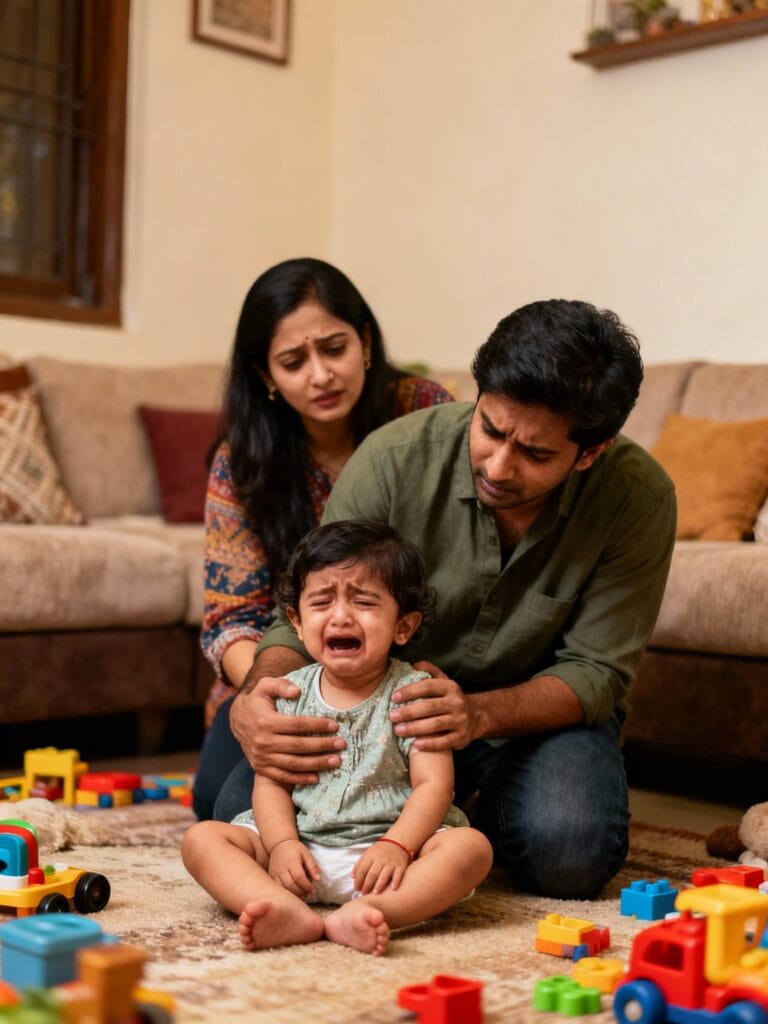
- Social and Emotional Skills: Lack of smiling, lack of interest in playing, or extreme, uncontrollable tantrums.
- Thinking Skills (Cognitive Skills): Inability to imitate actions or play simple cause-and-effect games.
Possible Causes of Delays: These can range from genetic defects (like Down syndrome or Fragile X syndrome), complications during birth, or environmental factors. Early detection is crucial because intervention therapies (Speech, Occupational, Physical Therapy) are most effective when started young.
[External Link Placeholder: Check the WHO Child Growth Standards for global benchmarks here]
7. Wrapping Up: Trust Your Instincts
Sometimes everything may seem just slightly off the normal growth of a child. Usually, this is temporary, and parents should not be overly concerned if the problems are not permanent.
However, armed with this comprehensive knowledge of childhood development stages, you are the first and best defense for your child. Trust your instincts. If a persistent worry keeps you awake, seek medical advice just to make sure the situation does not become worse.
Focus on creating a home filled with love, laughter, and encouragement. Your child is not meant to fit a generic chart; they are meant to follow their own unique, wonderful growth trajectory. Celebrate every little milestone, no matter when it arrives!
1 Comment
Hi, this is a comment.
To get started with moderating, editing, and deleting comments, please visit the Comments screen in the dashboard.
Commenter avatars come from Gravatar.